
 NovaCube
 Cerebro
 The Sites
 Cart2U
 NovaBoyle
 MeridianEnterprise SuiteAI staffAboutBlogTrust & securitySign inNovaCubeCerebroThe SitesCart2UNovaDyne customer portal
By Stanley — Founder, NovaDyne · September 2026 · 9 min read
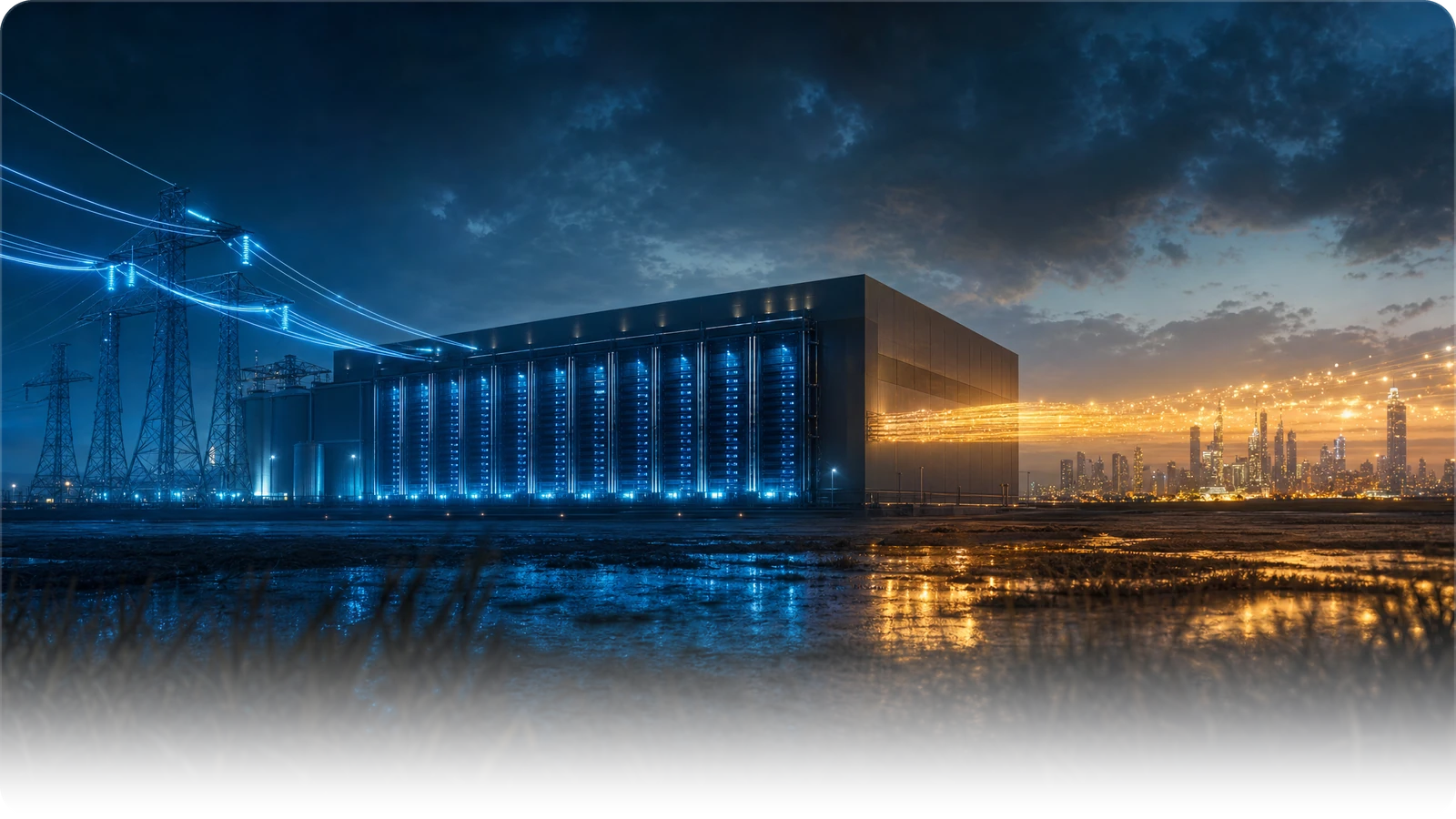
Electricity in one end. Thinking out the other.
At a wedding dinner a couple of weeks ago, my cousin’s husband — he runs a tyre shop in Klang — leaned over somewhere between the shark fin soup and the fish and asked me the question I get more than any other.
“Stanley, you do this AI thing right? So what is it actually? Like, what is it?”
I gave him a terrible answer. Something about models and training data and how it predicts the next word. His eyes drifted off somewhere behind my shoulder and after about forty seconds we were talking about football instead.
That answer has been bothering me ever since. He didn’t ask a stupid question. He asked the only question that really matters, and I answered it like an engineer instead of like a person.
Then yesterday I sat and watched a talk that finally handed me the words. Jensen Huang — the man who runs Nvidia, whose chips almost all of this runs on — spent half an hour in front of a room of G20 ministers with no slides and no jargon, and by the end I had the article I’d failed to write at that wedding dinner. The narrative is his. What I’ve done with it is mine. I’ve put the source at the foot of this page so you can go and watch it yourself, and I’d recommend it.
So this is my second attempt at answering my cousin’s husband. If you’re not technical, this one is for you. No equations, I promise.
Here’s the idea that made it click for me.
A hundred and something years ago the world worked out how to package up something invisible and sell it. You couldn’t see it, hold it, or explain it to your grandmother, but you could meter it and bill for it. We called it electricity, and we priced it in cents per kilowatt-hour. Nobody in 1900 understood what was happening inside the wire. They just knew that when they paid for it, the light came on.
AI is the same trick, one level up.
You put electricity into a very particular kind of computer, and what comes out the other side is a stream of numbers called tokens. A token is a small piece of an answer — a fragment of a sentence, a piece of an image, a step in a plan. Stack enough of them together and you get a paragraph, a design, a diagnosis, a written reply to a customer.
And they’re sold exactly the way electricity is sold. Not cents per kilowatt-hour. Dollars per million tokens.
That’s it. That’s the whole business. Electricity goes in one end of the building, and thinking comes out the other, metered and billed like water.
The word for it is a factory, and I think that’s exactly right. It’s the least mystical way to look at AI and also the most accurate one. When people ask me whether AI is “real” or “a bubble”, I now ask them the same thing back: is a power station real? Because underneath the marketing, that is what is being built.
The second idea — the one I wish someone had told me five years ago — is that AI is not one thing. It’s five things stacked on top of each other, like a cake.
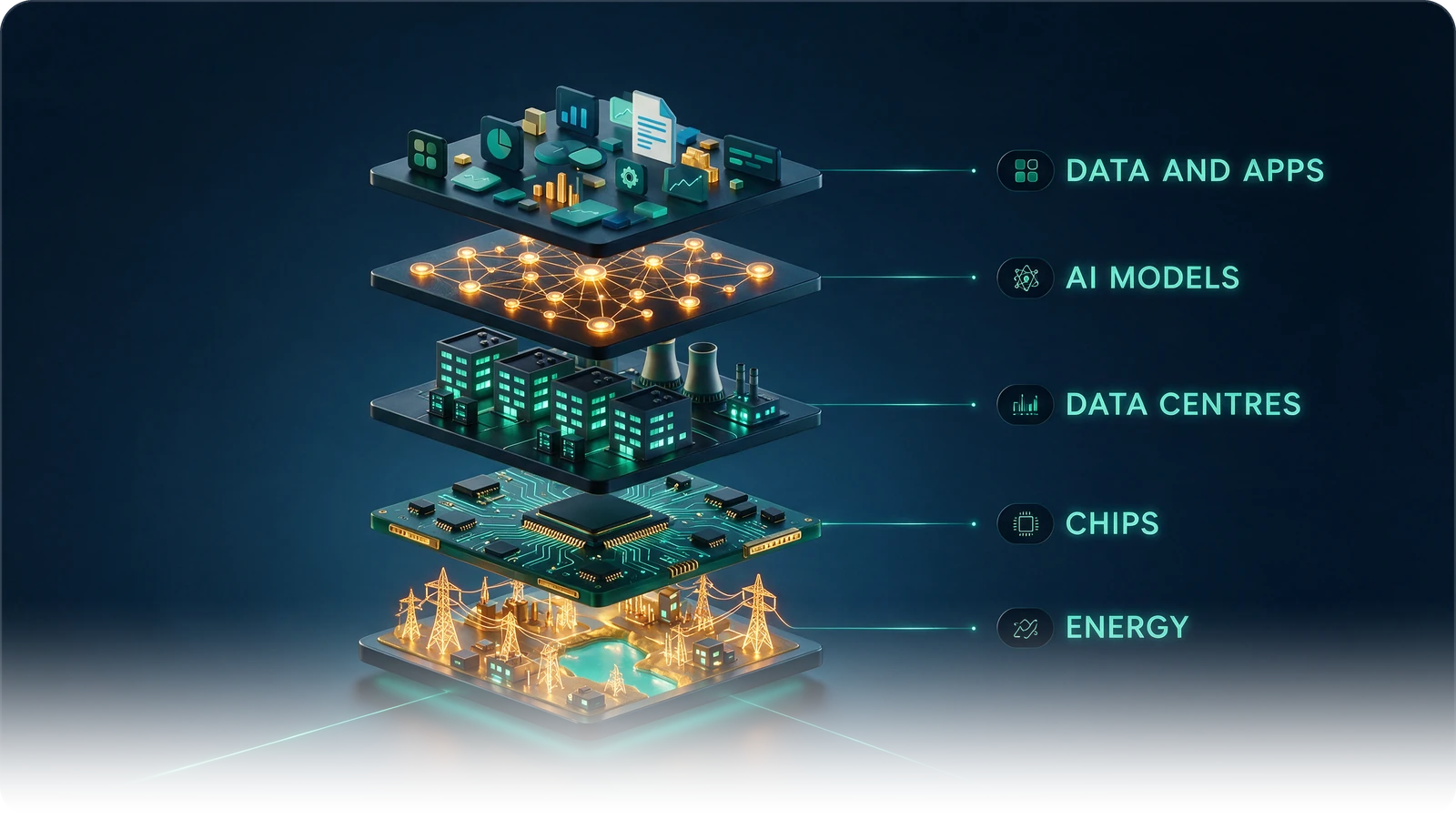
Most people think AI is the fourth layer. It is a five-storey building.
Layer 1 — Energy. The bottom of everything. No electricity, no thinking. This is why you’re suddenly reading news stories about tech companies buying power plants. They’re not diversifying. They’re buying the raw material.
Layer 2 — Chips. The specific kind of processor that can do this. Not the one in your laptop. This is Nvidia’s floor of the building, and it’s the reason a chip company became one of the most valuable companies on earth.
Layer 3 — Infrastructure. The buildings. Land, power, cooling, racks — the data centres where the chips actually live. The figure quoted in that talk made me sit up: roughly fifty to sixty billion US dollars for one gigawatt of capacity — more than double what it costs to build a semiconductor fabrication plant. These are the biggest physical objects humanity is currently constructing.
Layer 4 — The models. ChatGPT, Claude, Gemini, the open-source ones, the ones trained on protein structures instead of English. This is the layer most people think AI is. It’s actually the fourth floor of a five-storey building.
Layer 5 — Data and applications. The top. This is where AI stops being a science project and starts being your invoice getting issued, your customer getting answered at 2am, your stock count being right on Monday morning.
Now here’s why I’m making you sit through a cake metaphor.
The advice to that room of ministers was blunt: no country has to win every layer. Pick the ones you can realistically play in. But every one of them, without exception, has to push adoption — getting AI actually used, in real industries, by real people.
Swap “country” for “company” and it’s the same advice. You are never going to build a chip. You will probably never train a model. You live on layer five, and layer five is where all the value gets collected anyway. The people who made money from electricity were not mostly the people who built the generators. They were the ones who worked out that a factory could run at night now.
The next bit is the part I think trips up most business owners, because they tried ChatGPT in 2023, decided it was a clever toy, and quietly stopped paying attention.
A language model on its own is a brain in a jar. Enormously well-read. Can’t do anything. You ask it a question, it gives you back some words, and that’s the end of the transaction.
What changed — and this is genuinely the change that made AI useful for work rather than for amusement — is that we built a body around the brain. The industry calls it an agent harness; you’ll also hear it called an exoskeleton, which is the better picture. Strip away the vocabulary and it means the brain now has:
Brain in a jar plus a body equals an agent. And an agent is not a chatbot. A chatbot tells you what your top ten overdue invoices are. An agent chases them.

Same brain. The difference is the body.
Once you’ve got that picture, the rest of the AI news stops sounding like science fiction and starts sounding repetitive. Because it’s the same trick over and over, just plugged into different equipment:
Same brain. Different hands. That’s basically the whole robotics story in one line.
Now, the honest part, because I don’t think an article like this is worth much without one.
The people building this expect to reach AGI — artificial general intelligence, machines as broadly capable as us — within a couple of years, and some of them think we’re practically there already. I’m more cautious about that word than they are, and you should treat any date anyone gives you as a guess dressed up in a suit.
But sitting underneath it was the thing I’ve been trying to explain to clients for two years, put better than I’ve ever managed.
Getting to AGI does not solve your company’s problems.
Think about how this already works with people. The big technology companies hire the brightest graduates in the world — Stanford, MIT, genuinely some of the smartest people alive — and every one of them still needs months of onboarding, because raw intelligence was never the missing ingredient. Context is. Who the customers are. Why we do it this way. What went wrong the last time someone tried that. Who to ask. What matters here.
I’ve watched the same thing at my own far more modest scale, with far less famous CVs. The clever new hire isn’t useful in week one. They’re useful in month four.
It’ll be exactly the same with AI. Nobody is going to flip a switch in 2028 and watch their business become 30% more productive overnight. You’ll do what you’ve always done with a bright new hire: give it context, give it purpose, show it the ropes, check its work for a while.
Which leads to the line I keep repeating to people:
Tasks get automated. Jobs don’t.
A job is purpose, context, judgment and responsibility. Inside that job there is a great deal of typing, copying, chasing, checking and re-keying. That is the part the machine is coming for — and honestly, good. I have never once met a business owner who told me their favourite part of the week was reconciling delivery orders.
I want to deal with this properly rather than skip past it, because it comes up in every conversation I have and dismissing it is both rude and lazy.
There’s an analogy from that talk I hadn’t heard before and haven’t stopped thinking about. There was a period when airlines competed on safety in their advertising — my plane is safer than their plane. It didn’t work. Passengers didn’t want to be sold safety. They assumed safety, and they took it as the airline’s job to deliver it. What they actually wanted to hear about was where the plane could take them.
I think that’s right, and I think it cuts both ways. Safety is the builder’s responsibility, not the customer’s burden. If you’re buying AI for your business, you should not have to become an expert in it to be safe — that’s on us, the people selling it, and any vendor who tells you their AI never gets anything wrong is lying to you. It still gets things wrong. You design for that: check the steps that matter, keep a human on the decisions with consequences, and let the machine have the rest.
But the flip side is the one that keeps me up at night, and it applies to Malaysian businesses as much as to the countries in that room. Asked what the worst outcome of all this could be, the answer wasn’t robots, and it wasn’t job losses.
The worst outcome is that you don’t use it. That everyone else does, and you get left behind.
I’ve watched that movie locally three times already. The shops that took cards in the late 90s. The restaurants that got on delivery apps in 2015. The stalls that put up a QR code in 2020. Every one of them looked slightly premature at the time. Every one of them owned the five years that followed.
If you take one practical thing from this, take the answer that room got to “how should we invest in this” — it translates almost perfectly from a country to a company.
Use off-the-shelf AI wherever you can. Don’t build what you can subscribe to. We use other people’s AI inside NovaDyne every day, and we’re an AI company.
But don’t outsource all of your intelligence. Your customer history, your pricing logic, your supplier quirks, the way your business actually works — that’s yours. Feeding it into a generic tool and hoping for the best is not a strategy. The value shows up when the intelligence is wired into your data, doing your work. That’s the layer-five point again, and it’s the whole reason we build what we build: an ERP that runs your back office, a website that answers your enquiries, a counter system for the coffee shop, a research assistant that keeps the lab’s formulas inside the lab.
And start with the grind, not the glamour. Don’t try to “adopt AI”. Pick the one job in your week you hate most — the one that’s repetitive, rules-based, and eats an afternoon. Start there. It’s the fastest way to find out whether any of this is real for you, and it costs you an afternoon to find out.

Somebody still has to decide what to think about.
That’s what I should have told my cousin’s husband over the shark fin soup. AI is a factory that turns electricity into thinking. Somebody has to decide what to think about, and that’s still you.
So — same question I always ask, and I do read the replies: what’s the one task in your business you’d hand over tomorrow if you trusted the machine to do it?
Stanley is the founder of NovaDyne, an AI-first software company — novadyne.io · Views on future technology are forward-looking opinions; the honest answer to “when” is always “nobody knows exactly.”
Jensen Huang was speaking with US Commerce Secretary Howard Lutnick at the G20 Innovation Ministerial in Chapel Hill, North Carolina, on 2 September 2026. The framing this article is built on is his — the five-layer cake, the token-as-kilowatt-hour comparison, the airline safety analogy, and the “worst outcome is being left behind” line. The opinions about your tyre shop are mine.
Previously from the founder: The Next Wave →